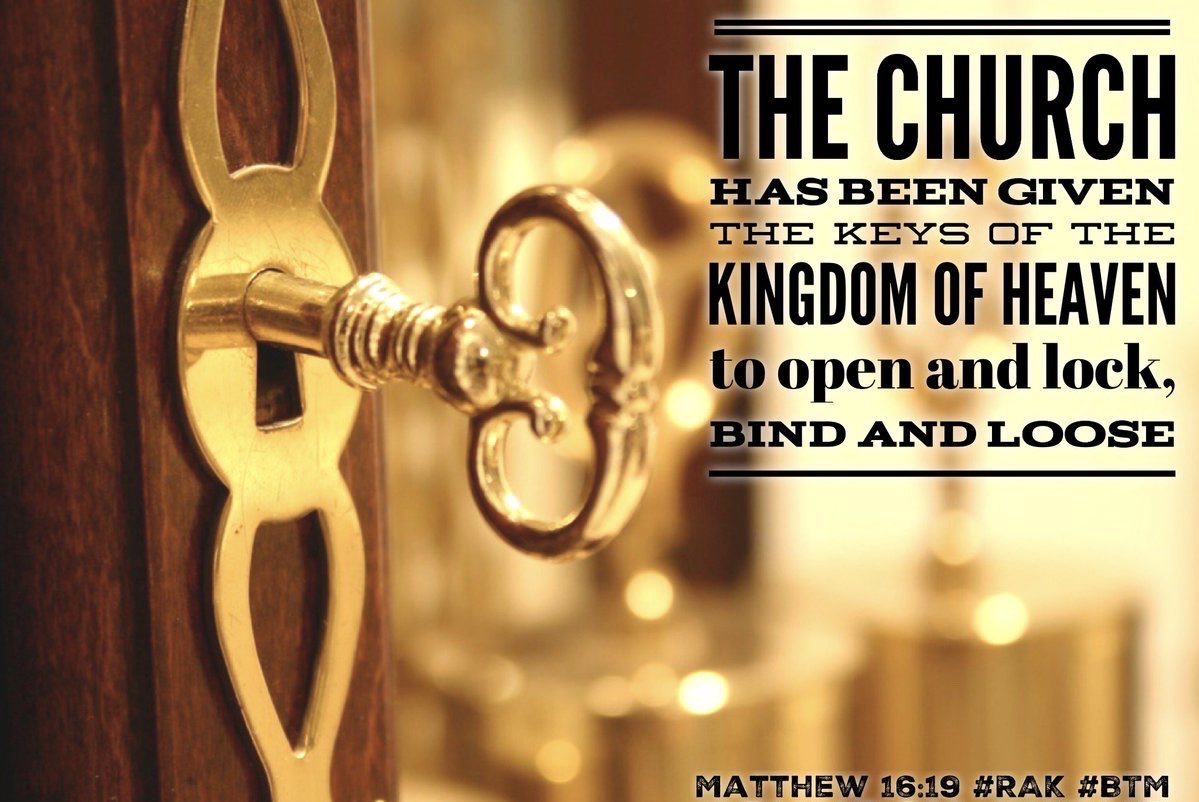
What were the first set of keys you ever received? For some, it might have been keys to their family home. For others, it might have been keys to a car, another vehicle, or even keys to their church. Earlier this year when we were discussing ministry with younger people in our parish, we talked about keys and why keys are important. Keys represent access. When we have keys, we have the freedom to open or close doors, both for ourselves and for others. Receiving keys shows that others trust us to use them wisely and they consider us to be mature enough to not misuse them.
What do you think was going through Simon Peter’s mind when Jesus said he was giving ‘the keys of the Kingdom of Heaven’ to him (Matt 16:19 NLT)? Was he thinking what some young people might when they are given the keys to their house, that he just couldn’t wait to invite his friends over? Or was he as excited as someone who has just got their driver’s license and wants to take a car for a drive? Or might Simon Peter have been more cautious with the keys, not wanting to take on all the responsibility and preferring Jesus to take the wheel for a while longer?
This is a difficult text because Christians over the centuries have understood it in a lot of different ways. Reading various English translations can make us wonder what these keys are for and what they do. For example, the New Living Translation, which we heard read this morning, talks about the keys to the Kingdom of Heaven giving Simon Peter the authority to forbid and permit, both on earth and in heaven. The Contemporary English Version talks about the holders of these keys allowing or not allowing something. The Easy Reading Version says that these keys allow the holder to speak judgment and forgiveness. The New International Version is close to the original Greek by saying that these keys bind and loose. The New International Reader’s Version, an edition of the NIV for younger readers, translates Jesus’ words as locking and unlocking. With such a wide variety of interpretations, we can be left wondering exactly what these keys that Jesus gave to Simon Peter do!
Lutherans have understood this passage as referring to the forgiveness of sins and opening the door to the Kingdom of Heaven. In his Small Catechism, Martin Luther used Jesus’ words from Matthew 18:18, which are identical to these words in Matthew 16:19, to teach that when a Christian forgives another person, it is as if Christ himself were forgiving that person. The image it conveys is that sin locks us up in chains so our freedom to love God and love others as he wants us to are lost. When God forgives us because of everything Jesus has done for us in his life, death and resurrection, he unlocks those chains and sets us free. The binding and the loosing the original Greek text talks about is referring to us and our sins. When we are not forgiven, we remain bound in the chains of sin. When we are forgiven, those chains are unlocked and made loose so we can love God and others in faith.
At the same time, the keys Jesus gave to Simon Peter also unlock the gates of heaven to us. There is a popular idea that Saint Peter, the person to whom Jesus gave the keys to the Kingdom of Heaven, stands at the pearly gates of heaven and either locks or unlocks these gates to let a person into heaven or to keep them out, usually based on how they lived their lives. The picture the New Testament gives us is very different. Jesus gave Simon Peter the keys, but they lock or unlock our entry into the Kingdom here and now based on our faith. As soon as they keys unlock us from the chains of sin, the gates of heaven are also unlocked so we can live here and now as citizens of heaven. It’s important to understand that in Matthew 4:17, 10:7, Mark 1:15, and other places, Jesus talks about the Kingdom of Heaven as a present reality, not just a place we go when we die. The gates are opened for us and we have access to Christ’s Kingdom now through forgiveness and faith in Jesus as the one who has already done everything necessary to give us a place in his Kingdom.
The forgiveness of sins and access to the Kingdom of heaven is not just something Jesus gives to us. Like receiving the keys to our family home or car, it is something we can share with others. Jesus unlocks our chains and gives us access to his Kingdom so we can invite our friends and others to celebrate and share in his gift to us. We do that when we use the keys Jesus has given us to set others free and give them access to the Kingdom as we forgive others in the same way Jesus forgives us. As people to whom Jesus gives the keys to the Kingdom, we have the opportunity to set others free and open the Kingdom to them by extending Christ’s forgiveness to them. Sadly, many in the church over the centuries have wanted to use these keys as a weapon, threatening to lock others out if they don’t do what they want or meet certain conditions. When we trust that God ‘wants everyone to be saved and to understand the truth’ (1 Timothy 2:4 NLT), we give others the opportunity to encounter God’s grace and come to a saving faith when we loosen the chains of sin and unlock heaven’s gates by forgiving people who have sinned against us.
This is not just a power God gives to our pastor. He gives it to all his children. There are those who argue that Jesus just gave the keys to Peter, so he only authorizes pastors or priests to use the keys. When we read Matthew 18:18, however, we hear Jesus saying these same words to all the disciples, who represent all Christians. In the same way that every member of a family can have keys to their home, or every child with a license can drive the family car, as God’s children and citizens of Christ’s Kingdom, we can all use the keys Jesus has given to his church. Whenever we forgive others, we use the keys to loosen the chains of sin and unlock the Kingdom of Heaven for them as if it was Christ himself!
It can be hard to forgive others because, let’s face it, they don’t deserve it. If we were good enough to deserve forgiveness, we wouldn’t need it. It is central to the nature of forgiveness that it can only be given to people who don’t deserve it but need it. Jesus didn’t give the keys of the Kingdom of Heaven to Peter because he deserved it somehow. Jesus gave them to him as an act of grace so he would extend that grace to others who, like him, needed it but didn’t deserve it – people just like us. It is an honour to be given keys and granted access to places like homes and cars through those keys. They are given in the hope that the keys will be used wisely and for the good of people. In the same way, Jesus gives us the keys to the Kingdom of Heaven so we can loosen the chains of people who are tied up in sin, and open to them the gates of the Kingdom of Heaven. Who might that be for us this week?
More to think about or discuss:
- What were the first keys you ever received? What was your reaction to receiving them?
- How does your Bible translate what Jesus says in Matthew 16:19? What challenges, confuses, or encourages you about these words?
- If we understand Jesus’ words as authorizing us to loosen people’s chains and open the Kingdom of Heaven to them by forgiving them, who is one person in your life that you could do that for this week?
 Pastor Eugene Online
Leave a comment