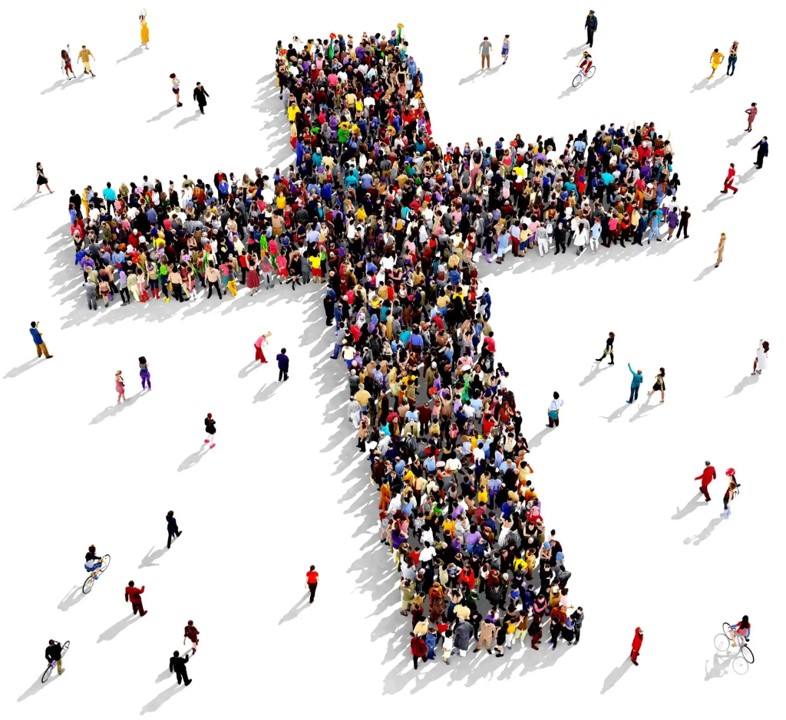
What do you think of when someone uses the word ‘church’?
The word ‘church’ can carry with it a few different meanings. For example, for a lot of people, a ‘church’ is a building where people gather for worship. For others, it might be the worship service that happens in the building. Still other people might think about the organisation which oversees and governs the work of the congregation or parish, with its boards, councils, and committees.
While these various ways of thinking about ‘church’ all have their place and purpose, when we read the New Testament, we see that the people who wrote those letters thought about ‘church’ in a very different way.
In the first century of the Christian era when the letters of the New Testament were written to the young Christian communities around the Mediterranean Sea, they didn’t use the words ‘church’ to mean a building because they didn’t own buildings which were especially dedicated to the worship of God like we do. Instead, these communities of faith met in people’s homes. In the same way, ‘church’ didn’t refer to their worship services because, as far as we can tell, a formalised pattern of worship hadn’t emerged yet. Neither did the authors of the New Testament in the early centuries use the word ‘church’ to mean a structured organization because that hadn’t developed yet either.
Instead, when we look carefully at the use of the word ‘church’ in the New Testament, it usually refers to people who formed a community of faith who were learning to live in the way of faith and love that Jesus taught.
Towards the end of this Sunday’s New Testament reading from Ephesians 1:15-23, we find one example where Paul uses the word ‘church’ in a way that is different from how we tend to use it in our own context. He writes:
God has put all things under the authority of Christ and has made him head over all things for the benefit of the church. And the church is his body; it is made full and complete by Christ, who fills all things everywhere with himself. (Eph 1:22,23 NLT)
There is a lot we could explore in these two verses about Jesus, his authority over creation, how he uses his authority for the benefit of the church, and why that is good news for us. However, Paul gives us enough to contemplate for this message today when he writes: the church is the body of Christ.
This is language which Paul uses a number of times in his letters, such as Romans 12:4-5, 1 Corinthians 12:12-30, Ephesians 4:11-16, and Colossians 1:24. These verses show us that when Paul uses the word ‘church’ he is not thinking about a worship service, an organisation, or a building, although Peter does used the image of a building to describe the church in 1 Peter 2:4,5. Instead, Paul identifies the ‘church’ as the ‘body of Christ’, people whom the Holy Spirit unites with Jesus as our head, and with others as members of Christ’s body, to be his physical presence in the world.
For many of us, this might be a very different way of thinking about church from what we have grown up with. However, when we begin to re-imagine ‘church’ from this perspective, it opens up new opportunities and possibilities of how we can be church in our context.
For example, to be the body of Christ means that our focus is on people. When the writers of the New Testament wrote their letters, they wrote them to communities of people who were in relationship with God through Jesus and with each other. They had their problems, challenges, and struggles in following Jesus, just like we do, however their focus was on loving each other in the faith that the Holy Spirit had given them. In the same way, when we identify the church as the body of Christ, our focus will be on people for whom Christ gave his live and how we can love, serve, and bless each other as members of the one body.
To be the body of Christ also gives us the opportunity to be much more organic and flexible. Our purpose is not to adhere to or serve rigid or restrictive structures or processes, but to put flesh and blood on the faith that we have in our relationships with Jesus, each other, and people who aren’t yet part of our faith community. Bodies grow, mature and change, and even though Christ doesn’t change and his love for us is constant, still his body will continue to mature and grow. Paul talks about this in Ephesians 4:15 when we writes about speaking the truth in love and ‘growing in every way more and more like Christ, who is the head of his body, the church’ (NLT). A living body isn’t static or stagnant, but it is organic and dynamic. God’s church, the living body of Christ, is called to be the same.
Being the body of Christ also gives his church purpose. Sometimes it can seem like the church’s purpose is to go to worship in a building on Sunday morning, or to get others to attend with us. When God’s Son took on human flesh and blood, his purpose was to fulfil God’s plan for redeeming, rescuing and renewing all things by bringing God’s saving goodness into the world and into people’s lives. As the living body of Christ, God gives this same purpose to us. The church, as the body of Christ, is God’s physical presence in the world. Our purpose is to bring God’s redemptive and saving love into the world through everything we say and do every day of our lives.
Our buildings, worship services and organizational structure exist to help us in this purpose. It is vitally important that we see our buildings, worship services and organizational structure as elements of church which serve the body of Christ in fulfilling the purpose God gives to his church. When we keep our identity as the body of Christ in focus, they can help us to live out our identity and the purpose of the church as we live as the physical presence of Jesus in the world, our communities, and the lives of the people around us.
More to think about or discuss:
What do you think of when you hear the word ‘church’? What does ‘church’ mean to you?
What do you think Paul meant when he wrote, ‘the church is Christ’s body’? How is that similar or different to the way you usually understand ‘church’?
What might our church be like if we identified first and foremost as ‘the body of Christ’? How might what we do and how we do it be similar or different in the future?
 Pastor Eugene Online
Leave a comment