The human body is an amazing thing. When our bodies are working well, we can do so much that is good, creative and beautiful. People are able to make incredible works of art, build impressive structures, grow magnificent plants and flowers, and perform outstanding sporting achievements. Even the everyday things we do like going for a walk, giving someone a hug or handshake, or making a cup of tea or coffee are possible because the many parts of our complex and intricate bodies are working well together.
We all know, however, that when something in our bodies isn’t working well, it effects every other part of our body and impacts what we do. Anyone who has broken a bone, rolled an ankle, suffered an illness, or even had a bad headache will understand that when even one small thing isn’t right with our bodies, it effects everything else. When one part of our physical bodies is struggling or suffering in some way, it impacts the whole body.
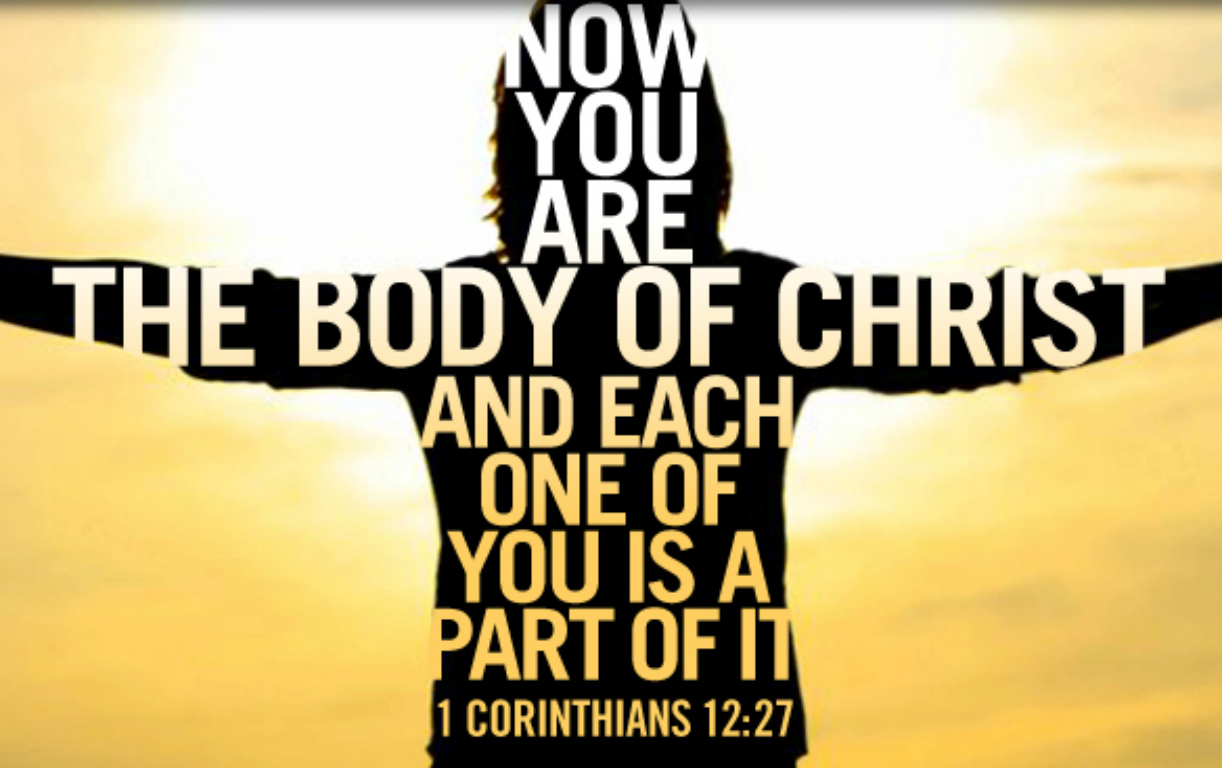
When Paul wrote about the body of Christ in 1 Corinthians 12:12-27 he used the image of a physical body to describe what it is like to be part of the spiritual body of Christ. He points out that when we were baptised, we were united with Jesus into his body with him as our head (Ephesians 1:22,23; Colossians 1:18). Through faith in Jesus, we are one with him and with each other as the Holy Spirit gives us different gifts to build the whole body up to maturity in faith, hope and love (Ephesians 4:15,16). The body of Christ is one of Paul’s main ways of explaining what it means to be the Church as we live in union with Christ and with each other through faith in Jesus.
Paul’s main point in 1 Corinthians 12:12-27 is that every member of the body of Christ is unique and different, and it is vital for the health of the body that we accept and embrace the differences which exist in the body. Our differences give us the ability to provide for each other in ways that others can’t. Every part of the body of Christ is important because it contributes something different to the body. Because of the connection we have with each other through Jesus, however, Paul writes that ‘if one part suffers, all the parts suffer with it, and if one part is honoured, all the parts are glad’ (v26 NLT). In other words, just like our physical bodies can struggle when one part is hurting, in the body of Christ, we all suffer when one part of the body is suffering.
From Friday 4th to Monday 7th October, delegates from across the Lutheran Church of Australia and New Zealand (LCANZ) met at our General Convention of Synod. One of the main proposals was to change the teaching of the LCANZ to allow women to be ordained as pastors in our church. After much discussion and debate, this proposal was passed, permitting both women and men to serve as pastors in the LCANZ. Many have enthusiastically welcomed this decision. However, there are others who believe that it goes against a clear command from God in Scripture and is not God’s will for his Church. While many are giving thanks to God for what they believe is a just and good outcome, others are hurting because of it and some are considering leaving the LCANZ over the decision.
Whatever our beliefs on ordination in the LCANZ might be, Paul reminds us that ‘we were all baptized by one Spirit so as to form one body’ (1 Corinthians 12:13 NLT). We all share in one common baptism and one faith in Jesus who was crucified and is risen again for our salvation. This baptism and this faith unite us with Jesus as our head into his body. In 1 Corinthians 12:12-27, Paul is saying that within this one body there always has been and always will be differences, and that is what makes the Church such a dynamic organism. However, it is important to understand that people are hurting because of the decision to change the church’s teaching on ordination. While some of us might want to celebrate something we have waited a long time for, we also need to recognise and acknowledge that others are hurting because of this and be sensitive to that. As Paul teaches us in Romans 12:15, now is the time for us to show sincere love for one another by rejoicing with those who rejoice and mourning with those who mourn this decision.
We do this under Jesus who is the head of the Church, his body. He is the eternal and authoritative Word of God who became flesh and made his home among us (John 1:14). For a lot of people, the question of ordination in the LCANZ has been about the authority of God’s Word. When the Bible talks about authority, it points us to Jesus, the living Word of God who became a human being to make us one with himself. All authority in heaven and on earth has been given to him (Matthew 28:18). In his authority as the eternal Son of God, Jesus doesn’t speak words of law to us. According to John 1:17, that is the job of Moses. Instead, Jesus speaks words of grace and truth which forgive us for our sin, reconcile us with our heavenly Father, breathe new life into us, give us a love that is stronger than death, break down the dividing walls between us, and unite us as his living body in the world. Since ancient times, the Church has believed and taught that the authority to forgive, reconcile and renew people is in the Word of God, not the person who speaks that Word. The words of the Bible point us to Jesus, the eternal Word who became a human being, so that through faith in him we can receive the life-giving grace of God.
There might be people among us for whom accepting this teaching will be difficult or even impossible. In the coming weeks and months, it will be important for us to suffer with those who are suffering over this decision as members of the body of Christ with them. It is also important to acknowledge that others in our church have been suffering over the question of ordination in the LCANZ for over three decades. The purpose of this message is not to say who is right or wrong, but instead to acknowledge the hurts God’s people are experiencing and to suffer alongside each other as Christ suffers for and with us. There might be some who disagree with this and would prefer that I give a firmer teaching on ordination in the LCANZ. If you are struggling with the change of teaching around ordination, please contact me so we can discuss your concerns or struggles and we can care for you properly. The beauty and the challenge of the body of Christ is that there will always be differences. But that’s the point. When we recognise our differences, and then accept and love each other with our differences, then the body of Christ comes alive in and through us.
More to think about or discuss:
- Has there been a time in your life when one part of your body was hurting? What happened? How did the hurt of one part of your body effect the rest of your body?
- What do you like about Paul’s image of the ‘body of Christ’ as a way of describing the Church? What do you find challenging about it?
- How can we care for each other, especially those who believe something different about ordination, during this time? How can we build each other up in faith, hope & love?
 Pastor Eugene Online
Leave a comment