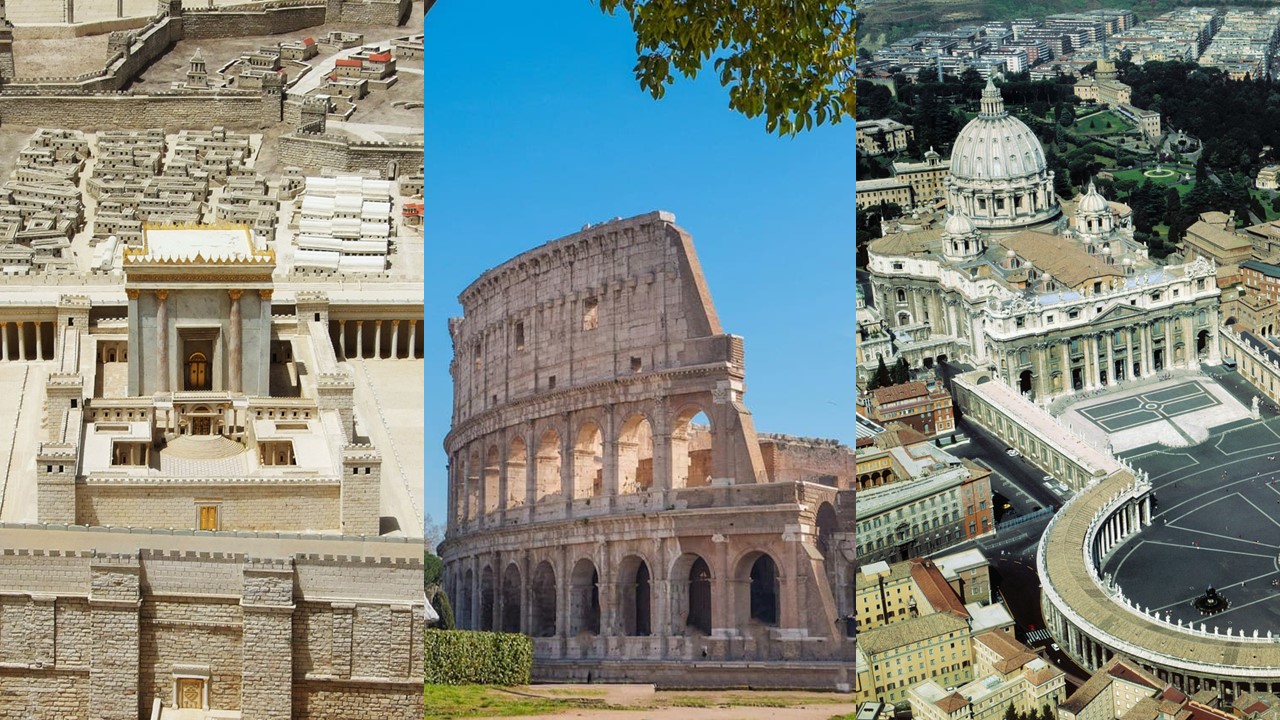
Most people who visit Rome would include St Peter’s Basilica on their list of sites to see. This incredible building was constructed in the fifteen hundreds and played a key role in the start of the Reformation which we celebrated a few weeks ago. The pope of the time had borrowed money from German bankers to build it and the debt was being repaid by selling indulgences, the practice which Martin Luther argued against in his 95 Theses.
St Peter’s Basilica was built using materials from another significant site in Rome, the Colosseum. Stone and marble from this ancient amphitheatre were used by those constructing St Peter’s and other buildings around Rome. The Colosseum, one of the ancient world’s most impressive arenas, was built in the first century of the common era. It was constructed to celebrate the Roman Empire’s victory over a Jewish rebellion in the late 60’s using money, resources and slaves which they looted from Judea and Jerusalem in AD 70. The Roman army had sacked Jerusalem, destroyed the Jewish temple, and dispersed the Jewish population around the Empire because of the rebellion.
Like dominoes through history, we can trace the links from the destruction of Jerusalem in AD 70, to the construction of the Colosseum, the building of St Peter’s Basilica almost 1500 years later, and the start of the Protestant Reformation, which gave rise to the Lutheran movement of which we are a part today.
When Jesus warned his disciples that the Jerusalem Temple would be destroyed in Mark 13:1-8, he was referring to the events which happened in AD 70. Bible scholars debate whether Mark wrote his gospel shortly after the death of the Apostle Peter in Rome about AD 64, or after the destruction of Jerusalem and the Temple in AD 70. Whenever Mark wrote his gospel, Jesus’ words in Mark 13 pointed to a time of war, the destruction of Jerusalem and the Temple, and the persecution of Jesus’ followers, all of which happened during Mark’s lifetime.
It is important to understand the history behind this reading because, as we listen to Jesus’ warnings, the events he is describing can sound like our own time. Two thousand years ago Jesus’ followers faced war, natural disasters, and persecution for their faith. In our own time we continue to hear reports of wars around the world, earthquakes and other natural disasters causing destruction and havoc, and followers of Jesus continue to be persecuted in many nations. Jesus could have been describing the world as we know it today when he spoke these words of warning.
Jesus’ words can also encourage and comfort us, just as they did two thousand years ago. Wars, deceptions and natural disasters might not sound very encouraging when he says that they are ‘only the first of the birth pains, with more to come’ (v8 NLT). Through Mark 13, Jesus continued to describe other events that would happen. His constant theme was to watch out, keep alert, and be on our watch (vv 9,23,33,35,37). Jesus began by describing the destruction that will come to the Jewish nation because of the rebellion against the Roman Empire in AD 70, but he used that as an opportunity to talk about his return at the end of time. In verses 28 and 29 Jesus explained that a fig tree can show us when summer is near. In the same way, when we see the signs he described in the world around us, we can know that Jesus’ return is on its way.
This is an important message for us to hear now just like it was two thousand years ago. The early Christians believed that Jesus’ return was immanent, so when they heard him instruct them to keep watch because his return was close, they took it seriously, even seriously enough to die for. In the two thousand years since then, some have tried to predict the exact date when Jesus would return, while others became more complacent. Obviously, the dates people expected Jesus to return were wrong because he didn’t turn up when they said. When we read Mark 13, we can ask how we can recognize the signs Jesus points out to us without panicking about the end of the world or becoming complacent.
As we listen to Jesus’ warnings and encouragement about reading the signs around us, we can wait in hope-filled expectation that his return is near, and still continue to do what God calls us to do every day. In verse 7 Jesus says that we will hear of ‘wars and threats of wars’ just as we do in our time, but he tells us not to panic. He reminds us that the end is coming so we don’t grow complacent, and we continue to be attentive to the coming of God’s kingdom around us. The events Jesus describes in Mark 13 and that we witness in our world today remind us that he is coming back. We don’t know when, but while we wait, he wants us to live as people who are prepared and waiting for him.
We do this by trusting that Jesus is coming back in glory to gather his people to him (vv26,27). We live as people who are prepared and waiting for his return by contributing to and participating in God’s work to redeem and renew the world by doing the good works he has already prepared for us to do (Ephesians 2:10). We live as people who are prepared and waiting for his return by giving witness to the good news of Jesus and the hope we have whenever we can. Jesus says that his followers will be given the opportunity to tell governors and kings about him when they stand trial before them for being Jesus’ followers (v9). Believing that Jesus is coming soon helps us have an urgency in our mission for the Kingdom of God and the gospel. We understand that we have a limited time to share the good news with people so they can find new life through faith in Jesus. The signs we see around us remind us that Jesus is on his way back, so we can dedicate ourselves to sharing his good news with others and they can receive new life through faith in him.
When we look at St Peter’s Basilica and the Colosseum in Rome, we can see the direct results of Jesus’ warnings to his followers that difficult times were coming for them. In our time and place, these buildings can remind us of two things. Firstly, Jesus knew what he was talking about, so we need to be listening to him. Secondly, even though the ancient Jewish people experienced the horrors he described, God used these events to spread the good news of Jesus to every nation so people could believe in him and receive new life now and forever through faith in him. God give us the grace to hear Jesus’ words, to trust them, and to wait in hope-filled expectation for his return by living faithfully as his followers.
More to think about or discuss:
- As you read through Mark 13, what are some of the events Jesus describes that we can see happening in the world today? What is your reaction to these events?
- Why do you think Jesus tells us not to panic? How can trusting in Jesus’ return help us to find peace, hope and joy with everything that’s happening in the world today?
- How can trusting in Jesus’ return lead us to live in a different way? How can it help us prepare to witness to him in our words and actions?
 Pastor Eugene Online
Leave a comment