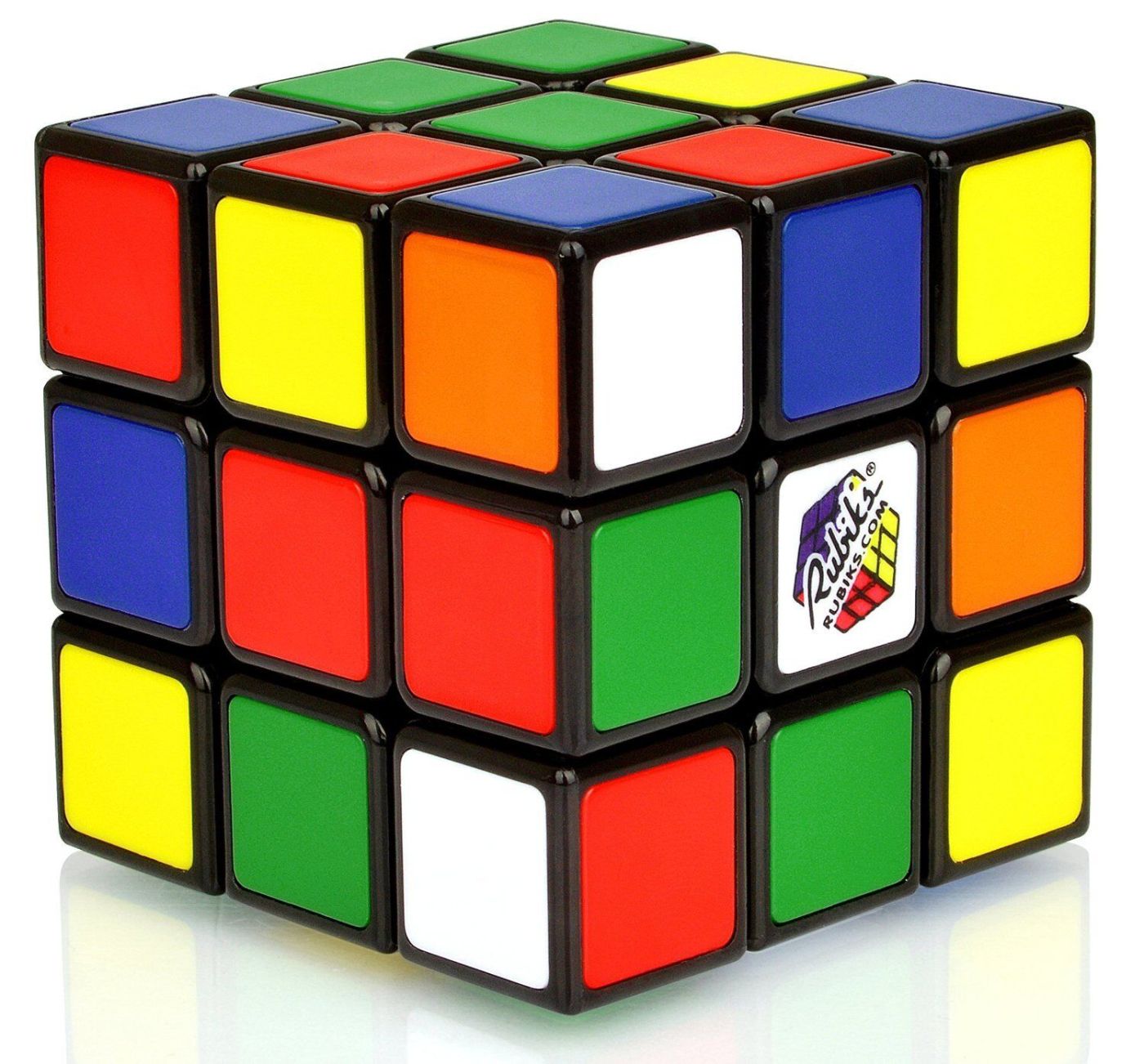
In 1974, a Hungarian sculptor and architecture professor named Ernö Rubik invented a puzzle which has challenged and frustrated people ever since. If you’ve never seen a Rubik’s Cube, it is a small cube with nine tiles on each face. When you buy a Rubiks’ Cube, the tiles on each face are the same colour and each face is a different colour. As you play with the cube, the colours get mixed up so there are different coloured tiles on each face of the cube. The aim of the puzzle is to restore the cube to its original condition by rearranging the tiles, so each face of the cube has just one colour on it.
If someone gave you a Rubik’s Cube with all the colours already messed up and you had never seen one in its original condition, you might think that was normal. However, when someone who can solve the Rubik’s Cube restores it to its original condition, we can see that the cube doesn’t have to stay a mixed-up mess. The point of the puzzle is to restore it to the way it was intended it to be. For someone who has struggled with and been frustrated by the Rubik’s Cube, when it is restored it to its original condition, it can bring a lot of joy.
When we look at the world, our relationships, or even our own lives, they can look pretty messed up. In so many ways, the world, our nation, the Christian church and even our community is conflicted, fractured, hurting or broken. Like a Rubik’s Cube with all the colours mixed up, the world can look pretty chaotic, a long way from how God intended it to be when he created it in the beginning. We can experience the messed-up nature of the world through grief, relationship difficulties, mental and physical illness, along with so many different stresses, pressures and worries in life. Like a messed-up Rubik’s Cube, we can think that this is the way it is and there’s nothing that can change that. To use a common Australian saying, we can think that ‘it is what it is’ and we just need to accept it.
But what if we don’t have to accept a messed-up world the way it is? What if, like a messed-up Rubik’s Cube, the world and our lives can be different? What might our lives be like if it was possible for a mixed-up world to be restored to the way the Creator always intended it to be from the beginning?
We don’t have to accept a messed-up world any more than we have to accept a mixed-up Rubik’s Cube. While we might not be able to restore the Rubik’s Cube to the way it was intended to be, there are people who can. In the same way, there is someone who can restore a messed-up world to the way God intended it to be in the beginning. When we discover that person and he starts working at restoring us and our messed-up lives to the way our Maker intended them to be, we can find a deep and lasting joy.
Christians celebrate the birth of Jesus at Christmas because he came to save the world. We can often think of this ‘salvation’ as Jesus dying on the cross so we can be forgiven and go to heaven when we die. While that’s true, there is a lot more to being ‘saved’ than just getting to heaven. There are a lot of different facets to being saved, kind of like the different tiles on the various faces on a Rubik’s Cube. One way we can think of being saved is Jesus restoring us and our world to the way God intended from the beginning. Just like a mixed-up Rubik’s Cube, our Creator didn’t intend for the world to be chaotic and messed-up. God created the world to be in perfect unity and harmony. Just like we might take our Rubik’s Cube to someone who can rearrange the tiles to restore it to the way its creator intended it to be, so Jesus came to take our messed-up world and restore its unity, harmony and beauty, returning it to its original state as our Father created it from the beginning.
Jesus did this by becoming part of our messed-up world. At Christmas we celebrate that God entered into our messed-up creation in Jesus to embrace it and make it right again. Throughout his time on earth, Jesus overcame the messiness of our mixed-up world by healing the sick, purifying the unclean, embracing those who had been rejected by society, forgiving sinners, and raising the dead. Through the life of Jesus, God gives us a glimpse of how he intended the world to be as Jesus began restoring it piece by piece. Jesus then suffered the brokenness of the world by dying on the cross. In his death, Jesus overcame the chaos of the world, not through a show of force or power, but through weakness, sacrifice and death. There’s nothing more messed-up than the Creator of the world dying because of a mixed-up world, but that’s what Jesus did for us. He suffered the brokenness of the world in his crucifixion, destroyed its power over us, then started restoring the world to its original condition by rising from the grave. In the birth, life, death and resurrection of Jesus, God took a messed-up world and began to restore it to the way he always intended it to be.
This message can give us a deep and lasting joy at Christmas and throughout the year. In this week’s Bible reading, Philippians 4:4, the Apostle Paul encourages us to ‘Rejoice!’ This is echoed in so many Christmas cards, carols and decorations which proclaim ‘Joy!’ For a lot of people, being joyful at Christmas can seem even more unrealistic than solving a Rubik’s Cube. When we are grieving, anxious, uncertain or facing hardships of any kind, to be full of joy might sound impossible. However, like someone solving our Rubik’s Cube, just because the world or our lives might be messed up, it doesn’t mean they have to stay that way. Jesus was born to save us and our world by returning all creation to its original condition. Jesus saves us by restoring us, our relationships and everything we experience back to the way God always intended them to be. Believing this good news can be the source of deep and lasting joy in our lives. Christian joy is more than feeling happy. Happiness can come and go, depending on our circumstances. The joy that comes through faith in Jesus runs deeper than our sadness, grief, struggle or pain. Even when we are going through the toughest or most messed-up of times, we can still find joy in the faith that through Jesus God is with us, God is for us, and God is restoring us, our relationships and the whole world to the way he always intended them to be in the beginning, just like a messed-up Rubik’s Cube.
If you don’t already own a Rubik’s Cube, you might like to consider asking for one for Christmas or buying one in the post-Christmas sales. Don’t be afraid to mix the colours up but think of the way they can represent our messed-up world. If you can’t solve the Rubik’s Cube, find someone who can. And when they do, remember with joy that Jesus was born into our messed-up world to restore it to the way God always intended it to be.
More to think about or discuss:
- Have you ever tried to solve a Rubik’s Cube? If not, is there another puzzle you’ve tried to solve but couldn’t? What was it like when or if someone else could restore it for you?
- In what ways do you experience the messed-up nature of the world? How can Jesus’ birth, life, death and resurrection make them right again?
- How might celebrating Jesus coming to save the world help you find a deeper and more lasting joy when you need it the most?
 Pastor Eugene Online
Leave a comment