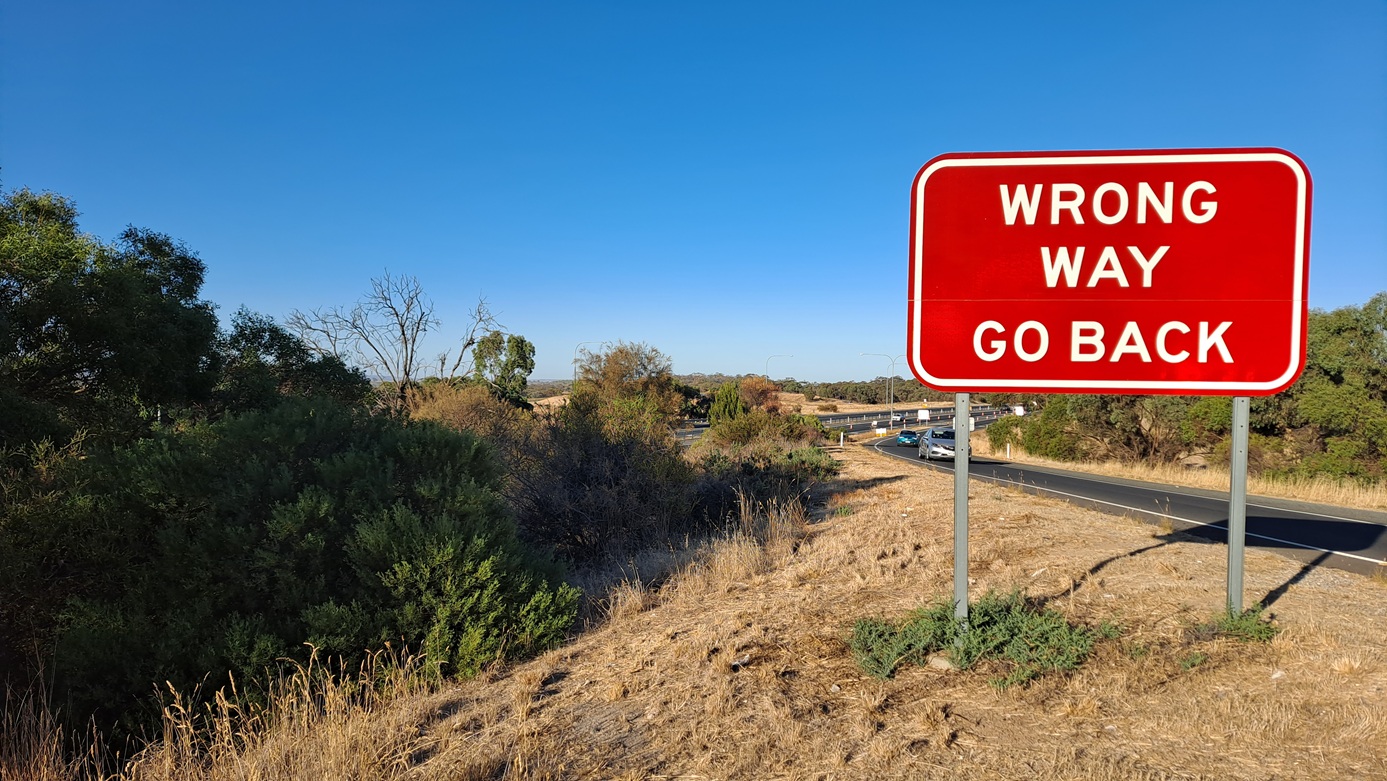
If you drive from Greenock towards Nuriootpa along Sir Condor Laucke Way, you go over a bridge which crosses the Sturt Highway. Just before you reach the bridge, there is a sign on the exit ramp from the highway facing the Nuriootpa-Greenock Road which reads, “Wrong Way. Go Back.” Hopefully you will never see this sign directly in front of you because it’s there to warn people who might have turned too early and are heading on to the Sturt Highway that they are driving into traffic coming from the opposite direction.
The purpose of this sign is to keep people safe. It is warning us that we are heading in the wrong direction and if we continue in that direction, we are in danger of having an accident which could result in serious injury to ourselves or to others. This sign is there to tell us to turn around and go in a direction that will be safer for us and for other people.
This Lent, as we explore what each week’s Bible readings tell us about God’s love for us in Jesus, trusting in his love, and showing his love to the people around us, this week’s gospel from Luke 13:1-9 might not seem to have much love in it. Jesus uses some pretty harsh language when he says, “unless you repent, you too will all perish” (vv3,5 NIV). Jesus sounds like a doomsday prophet, standing on a street corner carrying a placard announcing the end of the world, yelling at people to repent. His words might make us think about an old-school pastor thumping the pulpit as he delivers a fire-and-brimstone sermon about how evil we all are and how we need to change our behaviours if we are going to have any chance of making it into heaven when we die. These words from Jesus might not fit very well with the way we usually think about God’s message of love for us in the Bible.
Let’s try listening to them in a different way. The sign on the exit ramp of the Sturt Highway is there to warn us about approaching danger so we will turn our cars around. In calling people to “repent or perish” Jesus is doing the same. Jesus isn’t threatening us with death if we don’t do what he says but instead warning us that if we continue in the directions we are travelling in life, our destination might be more dangerous to us and to others than traffic coming at us from the opposite direction. We can hear Jesus’ call for us to repent as an act of love for us because he wants us to turn around and find life in all its fullness in him.
The prophet Ezekiel wrote, “As surely as I live, says the Sovereign Lord, I take no pleasure in the death of wicked people. I only want them to turn from their wicked ways so they can live” (33:11 NLT). We can imagine Jesus standing on the off-ramp of life trying to warn us that if we keep heading in the directions we are going, then we don’t have a future. One way we can think of it is that we are all heading in one direction or another in our lives. Either we are moving closer to God, or we are moving away from him. God is the creator and sustainer of all life, so moving closer to God gives us the full and abundant life Jesus promises us in John 10:10. Moving away from God means we move further and further from that life. In calling us to repent, Jesus is telling us that he wants us to experience the life which is full to overflowing with the goodness of God which he offers us. Instead of moving away from that life, he wants us to repent or turn around and embrace that life through faith in him.
Jesus illustrates this by telling the story of the fig tree in verses 6 to 9. When the fig tree isn’t producing fruit and the owner wants to get rid of it so he can plant something more productive in its place, the gardener intercedes for the fig tree and asks for another year to see if he can turn the fig tree around. The gardener doesn’t threaten the fig tree by yelling at it or telling it to produce some fruit or else. Instead, the gardener promises to ‘give it special attention and plenty of fertilizer’ (v8 NLT). The gardener doesn’t bring out the axe and leave it near the fig tree as a reminder of what’s coming if it doesn’t do the right thing. The gardener shows grace and love to the tree by looking after it, caring for it and feeding it in the hope that it will produce good fruit.
There is a stark contrast between Jesus’ harsh-sounding warning to ‘repent or perish’ and the tender care shown by the gardener. This contrast teaches us something about the nature of repentance. People rarely change or turn the direction of our lives around through threats or punishment. People are more likely to turn our lives around when we are promised something better. Jesus seems to be saying here that repentance doesn’t come from being told that we’re going to die if we don’t change but from encountering God’s love and grace for us in Jesus. Like the gardener, Jesus doesn’t expect us to produce something we don’t have. God turns our lives around and back to him by giving us what he’s looking for in us by feeding us with the good news of Jesus, caring for us through his mercy and grace, and giving us the special attention of his love for us in the life, death & resurrection of his Son. What produces the change in direction in our lives is realising that what God is offering us in Jesus is so much better than where we were heading on our own.
This faith produces fruit in our lives. John the Baptist called people to ‘produce fruit in keeping with repentance’ (Matthew 3:8; Luke 3:8 NIV). He was telling us that when God changes our hearts and minds by turning them back to him in faith, it will show in the way we live. Paul was more specific by talking about the ‘fruit of the Spirit’ in Galatians 5:22,23. When we are growing in the life God plants in us through the gospel, we will become more and more loving, joyful, peace-filled, patient, kind, good, faithful, gentle, and self-controlled in what we say and do. All of this happens because of the special attention Jesus gives us through his good news, the way he feeds us with his love and grace, and turns us back to our heavenly Father who is the creator and sustainer of all life.
None of us would drive the wrong way down an exit ramp from a highway on purpose. We know it would be too dangerous for us and for others. However, it can be easy for us to choose paths in life that take us away from God’s life-giving presence. The season of Lent is a time to think about the direction we are travelling and the paths we are choosing in life, and to ask if they are bringing us closer to or further away from God, the creator and sustainer of life. If we are moving away from God, maybe this is the time to change direction and come back to him. Not because of threats or punishment, but because he loves us, has given his only Son to die for us, and because we believe in the life he gives us through his love.
More to think about or discuss:
- Why do you think there are signs saying ‘Wrong Way. Go Back’ on exit ramps from highways? Would you ever drive the wrong way down one of these ramps? Why not?
- What do you think of when you hear the word ‘repent’? Do you usually think of it in terms of turning away from something bad or towards something good? How can each make a difference in our lives?
- What might turning towards God and getting closer to him in faith, hope and love look like in your life this Lent?
 Pastor Eugene Online
Leave a comment