Some people have a gift for learning languages. They seem to have a natural ability to remember vocabulary, understand sentence structures, and talk with an accent which sounds like they have been speaking the language their whole lives. Others, however, can find learning a new language really difficult. It can be even harder when there are different letters to learn, or the language uses characters to represent words rather than an alphabet.
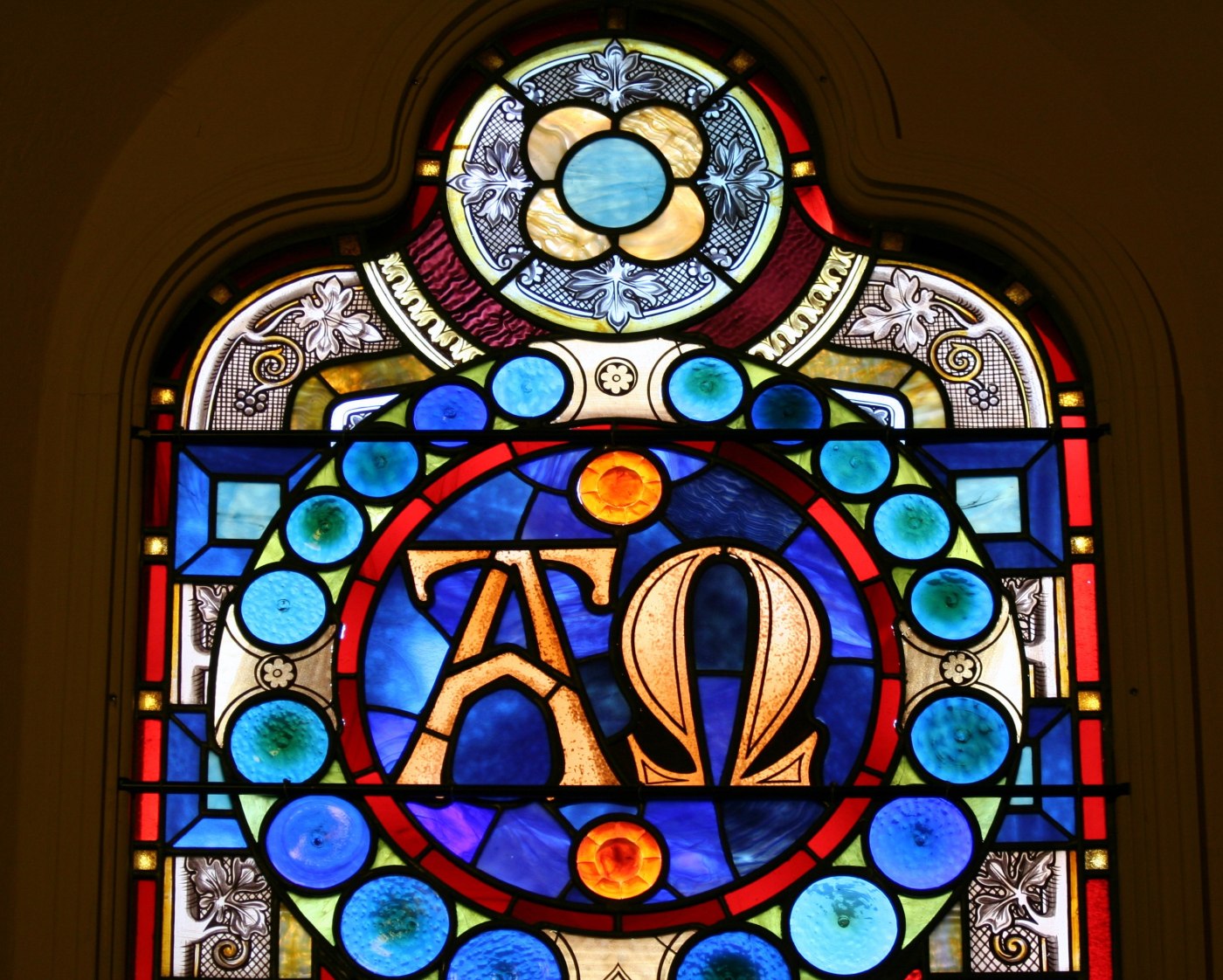
The New Testament was written in an ancient form of the Greek language. When we look at words which are written using the Greek alphabet, we can see that a lot of the letters look familiar to us because we also use them in the English alphabet. Some letters in the Greek alphabet, however, look very different. One letter that looks like its English equivalent is known as Alpha which is the first letter of the Greek alphabet. A letter which isn’t used in the English language is Omega which is the last letter of the Greek alphabet.
In Revelation 1:4-8, the Apostle John records God using these two letters as a name for himself. In verse 8 he writes, “I am the Alpha and the Omega – the beginning and the end … I am the one who is, who always was, and who is still to come – the Almighty One” (NLT). If John was writing in English, he might have recorded God saying, “I am the A and the Z” instead. God refers to himself as the Alpha because we read in the Book of Genesis that God existed before the start of Creation. God will still exist after everything that we know and experience in this world has come to an end. That’s why God also refers to himself as the Omega. Long after this world and everything in it has ceased to exist in its current form, God will still be. In describing God as the Alpha and Omega, John is telling us that God is eternal, without beginning or end.
This can be really hard for us to understand. Everything we experience in this world has a beginning and an end, so it’s virtually impossible for us to grasp something or someone that is eternal, without beginning or end. A common question that children can ask is, “Who made God?” When everything we experience has been made by something or someone, and when we believe that God made everything, it is natural to wonder who made God.
One way that we can try to explain the eternal nature of God is to imagine a piece of string or rope in front of us. When our eyes follow the rope in one direction we can’t see where it ends. As we look in the other direction, we can’t see its end that way either. As far as we can tell from our point of view, the rope is endless. This is one way we can try to illustrate the eternal nature of God. We expect that this infinitely long piece of rope must have a beginning because everything we experience in this world starts somewhere. In the same way, we also suppose that it must have an end because our view of reality is that everything comes to an end at some stage, no matter how much we might want it to last forever. John describes God as the Alpha because he existed before everything we experience. He is also called the Omega because long after everything else passes away, he will continue to exist. It doesn’t mean that God has a literal beginning and end. Instead, as we gaze along an endless piece of rope, God was there at the start of it, and he will be there at the end. This is the mystery of the eternal nature of God.
As the Second Person of the Trinity, Jesus participates in God’s eternal nature. At the start of John’s gospel, he points to Jesus as the eternal Son of God by calling him the Word of God which existed in the beginning and through whom everything that exists was created (John 1:1-5). Jesus, the Son of God, is the Alpha, not just in time but also in status and importance, because he existed before the creation of the world. He is also the Omega, the last not just in time, but also as the end point towards which all history is heading. In the Greek language, for something to be ‘the end’ doesn’t just mean that it is the last or final thing, but it is the purpose, the goal, or the culmination of everything that has come before it. Jesus is the Omega because the goal of Creation and everything that exists is to find newness of life and eternal existence through his life, death and resurrection for us.
Identifying Jesus as the Alpha and Omega, the First and the Last, gives us something that we can hang on to in faith and hope in our lives, especially when we are facing difficulties, uncertainties or hardship. If we return to the illustration of eternity being an endless rope which stretches further than we can see in both directions, we can also think about Jesus as being like that rope. As the Alpha, he existed long before all things so has always been a part of this world along with its struggles, suffering, hardships and pain. Jesus experienced this especially in his life, his suffering and his death. If we turn in the other direction, Jesus is also the Omega. He is the last of all things and the goal of all things, including our lives. Our risen Lord Jesus exists at the end of time, drawing all things into himself to make everything new. Jesus includes us in his goal and purpose to make all things new.
In our lives here and now, Jesus who is the Alpha and Omega, the first and the last, the beginning and the end of all things, is with us. He comes to us and makes himself known to us as the one who has experienced suffering in his death and overcome suffering in his resurrection so we can have something good and reliable to hold on to. His origin is beyond what we can see, and his destination is further than we can perceive. But John gives us the promise that the Alpha and the Omega, the first and the last, the beginning and the end, is here with us, drawing us along in himself towards the fulfilment and goal of all creation and history. All he asks us to do is hang on to him in faith. Whatever our earthly experience might be, whether life is full of joy or pain, sadness or celebration, Jesus who is the Alpha and the Omega is here with us, giving us something to hang on to as he draws us towards a better tomorrow and an eternity with him.
Learning a new language can be hard for a lot of people. We can even find it difficult to understand others and communicate clearly in the language we have spoken since birth. One way to get our ideas across is to use illustrations and images that help describe what we want to communicate. John’s use of the first and last letters of the Greek language, alpha and omega, illustrates God’s eternal existence. He always was and always will be. He meets us in our lives in Jesus, and when we hang on to him in faith, he draws us towards himself and our ultimate purpose and goal of new life in him, now and for eternity.
More to think about or discuss:
- Where do you see the symbols for the Greek letters Alpha and Omega? What can they mean to people in our time and place?
- What does John’s use of them in Revelation 1:8 say to you about the character and nature of God? What do they tell us about Jesus?
- How can it be good news for you that Jesus, our Alpha and Omega, who is first and last, the beginning and the end, meets us in our lives here and now?
 Pastor Eugene Online
Leave a comment