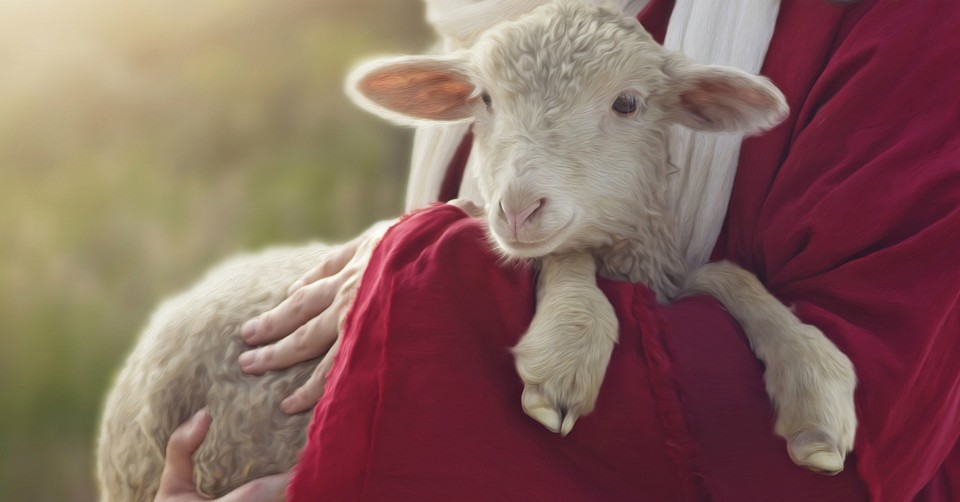
When we go shopping for meat at our local butcher or supermarket, there is usually a range of different meats that we can purchase. For example, we can buy beef, pork or bacon, chicken, or even kangaroo to eat. For a long time, the classic Aussie meat has been lamb. Probably most of us at one time or another have sat down to a lamb roast with our families or thrown some lamb chops on the barbecue. For a lot of Australians, talking about lamb will bring to mind roasts or barbecues shared with family and friends.
For the Jewish people of the Old Testament, talking about lamb would probably have made them think more about sacrificial offerings at their Temple in Jerusalem than a family barbecue or roast. When we read through the long list of sacrifices that were required by the Law of Moses in Exodus, Leviticus and Numbers, lamb features regularly as an animal that God’s people were to bring to the priests to be offered to him. For example, Leviticus 4:32-35 prescribed that people could bring a lamb as a sin offering. When the animal was sacrificed, the sin of the person would be atoned for, and the person would be forgiven. The Old Testament sacrificial system of worship taught that a lamb would carry the sin of the person, would die in the person’s place to remove the punishment they deserved, so the person could be forgiven for their sin and be free from the guilt of that sin.
It might sound strange or even barbaric to us that an innocent lamb had to die because of a person’s sin. However, that was how God dealt with the problem of people’s sin and freed them from their guilt until a better way was provided for us. Sin is destructive. It takes life away from both the person who sins and the person who is sinned against. Sin harms people physically, emotionally and spiritually. It damages relationships between people. For sin to be atoned for and for the harm that sin does to be healed, its destructive power needs to be removed by someone or something taking it away. God removed the destructive power of sin from people in Old Testament times by commanding them to offer a lamb. When the lamb was sacrificed, the destructive power of that sin was removed so people could be forgiven and the harm that sin caused could be healed. Without the lamb taking the sin, the harm and damage it caused would endure and people would remain captive to its power.
In this week’s Gospel reading, John 1:29-42, John the Baptist identified Jesus as ‘the Lamb of God who takes away the sin of the world’ (v29 NLT). The people who heard John’s words would have made the connection with the lambs who were offered as sacrifices at the Temple. They would have recognised Jesus as the Lamb whom God had provided, who was going to be offered as the ultimate sacrifice to atone for the sin of the whole world and liberate all people from the burden of guilt and the destructive power of sin. At this early stage in Jesus’ ministry, they probably didn’t understand what was going to happen and how Jesus would offer his life for us on the cross. However, identifying Jesus as the Lamb of God made such an impact on two of John’s disciples that they began to follow Jesus (v37), and Andrew brought his brother Simon to meet Jesus (vv40-42). By identifying Jesus the Lamb of God, they saw in Jesus the one who would atone for their wrongs, forgive them for all their sin, and free them from the weight of guilt and the destructive power of their mistakes, failures, shortcomings and flaws.
Jesus could take away the sin of the world because he substituted himself for us, just like the Old Testament lamb was substituted for the person who had sinned. Jesus took the full force of sin’s destructive power on himself as he suffered physically, emotionally and spiritually in his crucifixion and death. He was physically broken for us. He was abandoned, abused, and ridiculed by the people around him. Jesus endured the damage sin causes to our relationship with God when he cried out to his Father, ‘My God, my God, why have you abandoned me?’ (Matthew 27:46 NLT). Jesus took the full weight of sin’s destructive power on the cross, so we don’t have to carry it. Instead, we can be free from it, and we can find healing and life.
Faith in Jesus as God’s Lamb who was offered for us gives us freedom. John the Baptist identified Jesus as ‘the Lamb of God who takes away the sin of the world’ and not just ‘who forgives the world.’ He is telling us that our sin has been taken away and it is never coming back. Just like we can take a lamb chop from the barbecue and it’s never going to return to the hot plate because we have enjoyed eating it, so Jesus takes our sin away from us and it is never going to return. That is why the Apostle Paul addresses his letter to the early Corinthian Christians as those ‘who have been called by God to be his own holy people’, who he has made ‘holy by means of Christ Jesus, just as he did for all people everywhere who call in the name of our Lord Jesus Christ’ (1 Corinthians 1:2 NLT). He doesn’t describe them as ‘poor, worthless sinners’ even though, as we read in the letter, there were a lot of things happening in the Corinthian church that were not in step with what God wants for his people or the love that he teaches us. Instead, Paul referred to the Corinthian Christians as ‘holy’ because he believed that Jesus, the Lamb of God, had already taken their sin from them and had given his holiness to them. In the same way, our sin has been taken away by the Lamb of God, and he has given us his holiness so we can live as God’s dearly loved children. Because Jesus, the Lamb of God who takes away the sin of the world, has taken our sin with all of its destructive power on himself, we are free to live as God’s dearly loved and holy children in a new relationship with him, within ourselves, and with each other.
As we celebrate Australia Day next weekend, we might give thanks for the freedoms and blessings we enjoy in Australia with a lamb roast, some lamb chops on the barbecue, or maybe a good Aussie lamb yiros. Whether you enjoy some lamb on Australia Day or at another time, the next time you eat lamb you might like to think about Jesus, the Lamb of God who takes away the sin of the world, so we can be free from sin’s destructive power and free to live holy lives. And if the destructive power of sin every troubles you again, go eat some lamb and remember the Lamb of God who has taken away all your sin.
More to think about or discuss:
- What is your favourite way to eat lamb? Or, if you are vegetarian or vegan, what is your favourite substitute for meat? How might that lamb or its substitute remind you of Jesus who substitutes himself for us to take away the sin in our lives?
- What do you imagine life could be like if all the sin in the world was taken away? What might that suggest to you about what our lives can be like because Jesus has taken our sin away from us?
- Do you see yourself more as a sinner, a holy person, or in some other way? Why do you see yourself like that? How can trusting that Jesus, the Lamb of God, has taken away your sin help you to see yourself as God’s holy and dearly loved child? What difference might seeing yourself like that make to your life?
 Pastor Eugene Online
Leave a comment