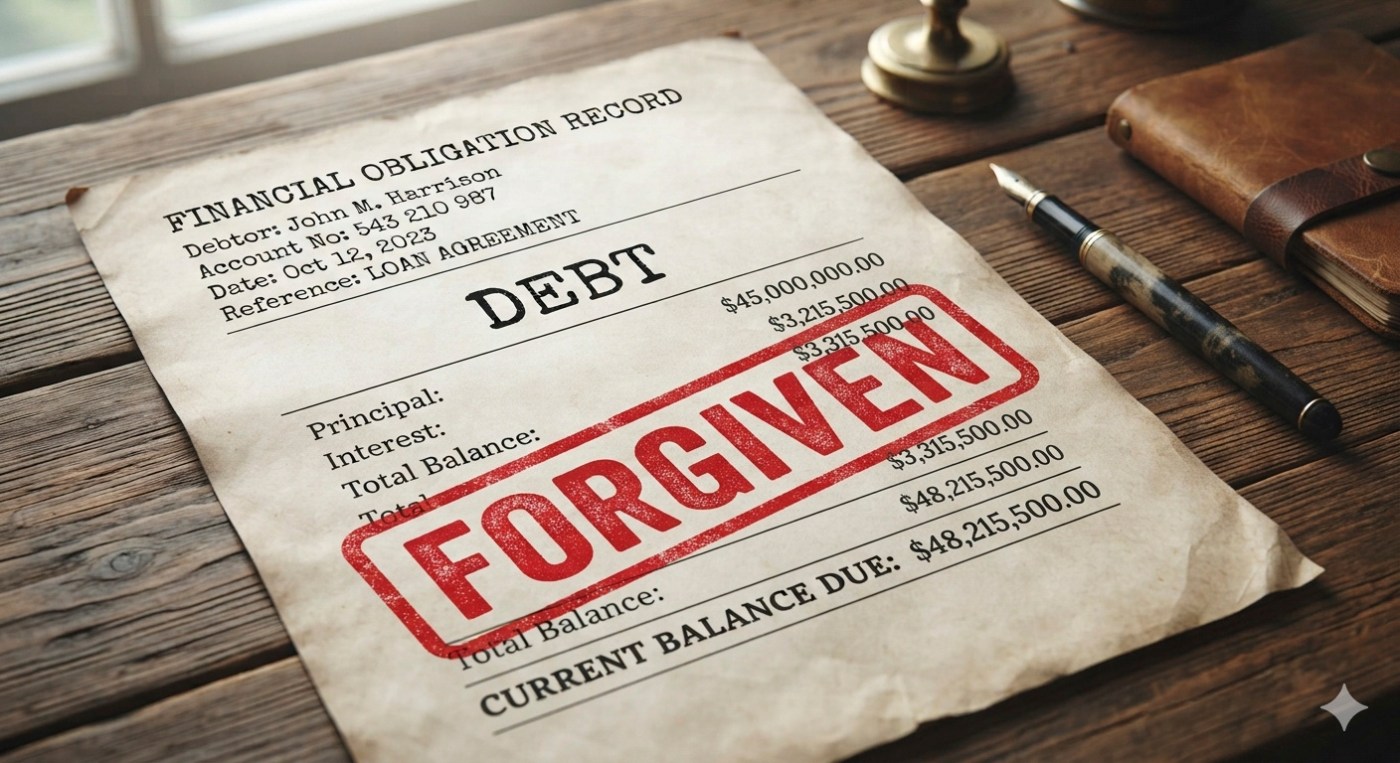
Just about every Australian adult lives with a certain amount of debt. For some, it might be a credit card debt of a few thousand dollars. For others, it might be a personal loan for a car, motorbike or overseas trip that could take years to repay. A lot of people have home loans or mortgages that they will spend most if not all their working lives trying to pay off. For farmers or others who make a living from the land, their debts can run into millions of dollars which they might never be able to repay fully.
Whatever our level of debt might be, what would it be like if someone paid your debt for you? It might be hard for us to imagine someone being that generous! However, it would be interesting to consider how we would react if someone cleared our debts for us by paying what we owed so we could be debt-free. Would we extend that same generosity to others? Or would we hang on to what we had for ourselves?
Last week we reflected on Jesus teaching his followers to go to people who have wronged us to reconcile with them and do what we can to restore our relationships with them in Matthew 18:15-20. Matthew continues with a question from Peter to Jesus about how many times he should forgive someone who sinned against him. In response, Jesus tells a parable which is often called the Parable of the Unforgiving Debtor in Matthew 18:21-35.
One thing that is staggering about this story is the amount of debt the servant owed his king. While the New Living Translation describes it as “millions of dollars” (v24), the original Greek text says he owed “10,000 talents” of silver coins. In New Testament times, a talent was a unit of weight roughly equivalent to about 35 kilograms. This amount of silver coins was roughly what a labourer in that time and place could earn in about 20 years. To owe 10,000 talents, then, would be about 200,000 years of wages. In our time and place, that ends up being billions of dollars! We can wonder what the servant was doing with all that money to accrue such a huge debt, but, in the end, Jesus is describing a debt the servant could never pay back.
What is even more staggering is what the king did when he told the servant to pay back what he owed. When the servant pleaded for mercy because he couldn’t pay, the king “was filled with pity for him, and he released him and forgave his debt” (v27 NLT). Faced with an impossible debt and a servant who couldn’t pay him back, the king released his servant from his financial obligation, cancelled the debt and let him go.
This becomes a beautiful picture of forgiveness. When we sin against people, we take something away from them and so we owe them because of the wrong we have done to them. It works the same with God. When we wrong each other, we become more and more indebted to God from whom all good things come. Jesus uses this image of an impossible debt to show us that no matter how hard we try, no matter how much good we try to do, our debt to our heavenly King is so great we can never repay it. Psalm 49:7-9 says,
Yet they cannot redeem themselves from death by paying a ransom to God.
Redemption does not come so easily, for no one can ever pay enough
to live forever and never see the grave. (Psalm 49:7-9 NLT)
Because of our sin and the wrong we do in our thoughts, words and actions, we have a debt to God which we can never repay.
Just as the king in Jesus’ parable had pity on his servant and cancelled his debts, so our heavenly king has mercy on us. He knows we can never repay the debt we owe him so he cancels our debts to him. Of course, debts don’t just disappear. The king in the story had to live with the financial loss that came with cancelling his servant’s debt. In the same way, God can’t just pretend our debt doesn’t exist. Someone has to pay our debt if it is to be forgiven. Jesus paid the debt we owe God and could never repay by giving his life for us on the cross. He gave his life as payment in full for all the wrongs, mistakes and sin we commit in our lives. Jesus voluntarily and freely gave his life for us on the cross to offer his life in exchange for ours and to make satisfaction for our sin. For his sake, our heavenly Father cancels our debt, forgives us for the wrongs we have done, and sets us free from what we owed him.
Jesus goes on to say that the servant who had been forgiven for his massive debt then demanded payment from someone who owed him a relatively small debt, basically the equivalent of three month’s wages compared to the billions he owed (v28). He would not forgive a small debt even though his enormous debt had been cancelled. This challenges us to think about the people who have wronged us. As people whose debts have been forgiven by our grace-filled King, what is the appropriate response towards those who have wronged us and who might owe us a small amount in comparison? Jesus’ message is clear: our debts have been cancelled by God’s grace and mercy, so he wants us to show the same mercy and grace to those who have wronged us or who might owe us in some way. When we trust that Jesus has paid our debts through his death for us on the cross, it follows that he has also paid the debts of those who have wronged us. It is wrong for us to hold people accountable for debts that Jesus has already paid in full through his death on the cross. As we have received the extraordinary generosity of our King who has cancelled our debts, it only makes sense that we extend the same grace and mercy to those who have wronged us by forgiving their debts to us as well.
Jesus concludes his story with some stern words. We could hear them as a threat, but let’s listen to them as a warning instead: “That’s what my heavenly Father will do to you if you refuse to forgive your brothers and sisters from your heart” (v35 NLT). Who might that be for you? Is there a person who has wronged you, who owes you because of something they said or did that took something from you, either physically, emotionally or spiritually? Jesus isn’t just talking about money when he talks about debts in this parable. He’s talking about anything that we think someone owes us because of the wrong they might have done to us. Jesus gave his life in our place to pay the debts we owe our heavenly King because of the wrongs we have done. Our debt is cancelled and we live as forgiven people. As we trust in God’s debt-cancelling love and mercy to us in Jesus, it just makes sense that we forgive others their debts towards us because Jesus has paid them in full too.
More to think about or discuss:
- What are your thoughts about understanding sin as a debt towards the person who has been wronged? What do you like about that image? What do you struggle with about it?
- What do you think it would have been like for the servant in Jesus’ parable for the king to cancel the debt he could never repay? What can that tell us about God forgiving us?
- In what ways can we behave like the servant towards the person who owed him a small debt? What does that say to you about how to treat those who have wronged you?
 Pastor Eugene Online
Leave a comment